Quick Definition: PLG supplies—standing for Parts, Lubricants, and Gear—are the essential industrial consumables and components required to maintain, repair, and operate heavy machinery. They represent the “indirect spend” critical for ensuring equipment reliability, preventing unplanned downtime, and maintaining safety standards across manufacturing, warehousing, and energy sectors.
Defining the Scope: What are PLG Supplies?
In the context of industrial operations, PLG supplies are the lifeblood of the facility. While capital equipment (the machines themselves) represents the “skeleton” of a factory, PLG supplies represent the “nutrients” that keep the system moving.
1. Parts (The Mechanical Core)
“Parts” refers to the mechanical and electrical components that wear out over time. These are the items that must be kept in stock to ensure a quick fix during a breakdown.
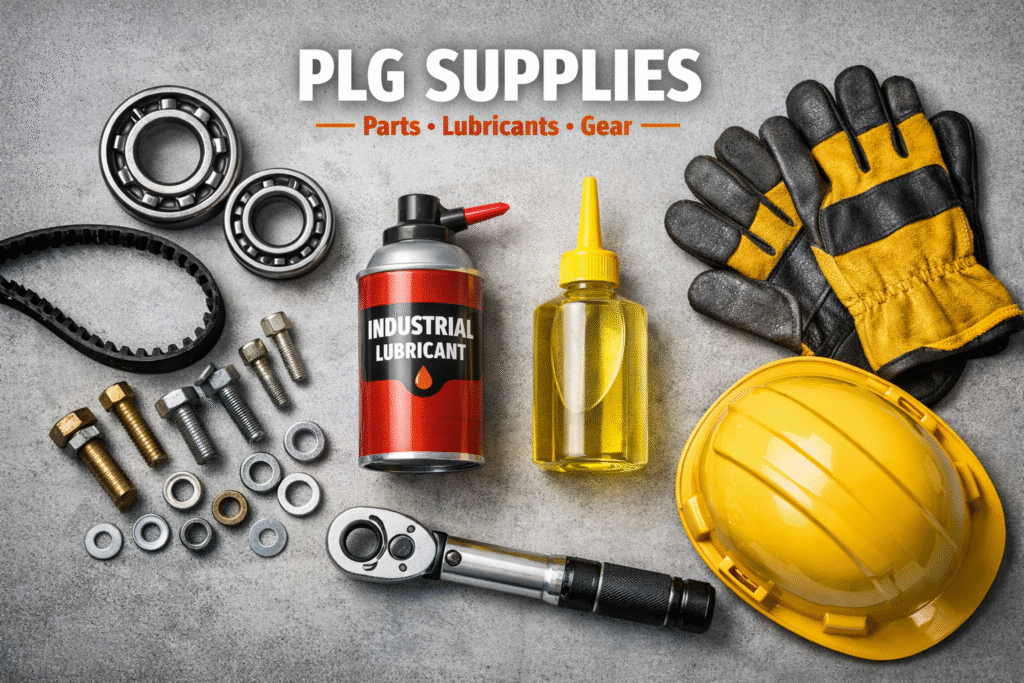
- Bearings and Bushings: Essential for reducing friction in rotating shafts.
- Power Transmission: Chains, belts, sprockets, and pulleys.
- Fluid Power: Hydraulic seals, pneumatic valves, hoses, and fittings.
- Fasteners: Specialized bolts, nuts, and hardware designed for high-vibration environments.
2. Lubricants (The Operational Fluid)
Lubricants are chemical agents used to reduce friction, dissipate heat, and prevent corrosion. Without the correct spare parts and lubricants, mechanical systems fail within hours.
- Industrial Oils: Gear oils, hydraulic fluids, and compressor oils.
- Greases: High-temp, water-resistant, and food-grade lubricants.
- Specialty Chemicals: Degreasers, anti-seize compounds, and cooling fluids.
3. Gear (The Human & Tool Interface)
Gear encompasses the industrial tools and safety equipment required to perform maintenance tasks.
- Maintenance Tools: Torque wrenches, diagnostic sensors, and precision alignment tools.
- Safety Gear (PPE): Hard hats, arc-flash protection, and specialized gloves.
- LOTO (Lockout/Tagout): Devices used to ensure machinery is de-energized during repair.
Tailoring PLG for Your Scale
Not every facility requires the same PLG strategy. The volume, complexity, and specialized nature of your industrial supplies change based on your operational maturity.
PLG Supplies for Startups and Workshops
For a new workshop or a hardware startup, the focus is on versatility.
- The Strategy: Invest in “multi-purpose” lubricants and a high-quality set of manual industrial tools.
- Goal: Keep the initial capital expenditure low while ensuring you have the basics for industrial maintenance as you scale.
PLG Supplies for Small Factories
Small factories often face the challenge of limited storage space and smaller procurement budgets.
- The Strategy: Focus on high-turnover maintenance parts and local sourcing to avoid carrying massive inventory.
- Goal: Use “just-in-time” logic to manage the cost of factory equipment without risking factory downtime.
PLG Supplies for Large Industrial Plants
For massive plants, the complexity of industrial operations requires a data-driven approach.
- The Strategy: Implement automated vending for PPE (Gear) and bulk-order contracts for specialized lubricants.
- Goal: Maximize equipment reliability through standardized parts across multiple production lines to simplify preventive maintenance.
The Cost of PLG Supplies
Understanding the financial side of procurement is essential for maintaining a healthy bottom line.
How Much Do PLG Supplies Cost?
Pricing for PLG supplies varies wildly based on specification. A standard ball bearing might cost $15, while a high-precision aerospace-grade bearing can exceed $500$. Generally, companies should budget between 3% and 7% of their total equipment value annually for PLG-related maintenance.
What Affects the Price?
- Material Fluctuations: The cost of steel (Parts) and crude oil (Lubricants) directly impacts your invoice.
- Specialization: Food-grade or explosion-proof ratings carry a significant premium.
- Lead Times: Urgent, overnight shipping for a critical part can double its effective cost.
How to Avoid Overpriced Industrial Suppliers
- Consolidate Vendors: Buying your parts, lubricants, and gear from one large distributor often unlocks volume discounts.
- Request Technical Data: If a supplier cannot provide an SDS (Safety Data Sheet), they are likely a middleman adding a markup without adding value.
- Audit Regularly: Compare your contract pricing against market benchmarks every 12–18 months.
Where Are PLG Supplies Used? (Industry Breakdown)
The application of PLG supplies varies significantly depending on the environment. Understanding these nuances is key to effective industrial operations.
- Manufacturing & Assembly: Focuses on high-cycle parts like pneumatic sensors and high-speed bearings to maintain production velocity.
- Warehousing & Logistics: Relies on drive belts, rollers, and specialized lubricants for cold-storage environments and ASRS systems.
- Energy & Utilities: Requires heavy-duty valves, high-pressure seals, and vibration-monitoring gear to prevent catastrophic utility failure.
- Construction: Utilizes PLG supplies for heavy earthmoving equipment, including hydraulic hoses and heavy-duty grease.
- Oil & Gas: Requires explosion-proof tools and corrosion-resistant fasteners designed for volatile environments.
Comparison: PLG vs. MRO vs. General Industrial Supplies
| Category | Definition | Focus Area | Cost Impact |
| PLG Supplies | Parts, Lubricants, Gear | Technical machine uptime | High (Directly impacts ROI) |
| MRO Supplies | Maintenance & Operations | General facility upkeep | Medium (Includes cleaning/office) |
| General Industrial | Generic hardware | Consumables | Low (High volume, low unit cost) |
Buyer Decision Signals: Choosing a Reliable Supplier
Selecting the wrong partner for your factory supplies can lead to more than just high costs—it can lead to safety violations and equipment failure.
Signs of a Reliable PLG Supplier
- Technical Expertise: Their reps understand the difference between lithium-complex and polyurea grease.
- Traceability: They provide certificates of conformance (CoC) for critical mechanical parts.
- Inventory Resilience: They maintain “buffer stock” for your most critical maintenance parts.
Red Flags to Watch Out For
- Inconsistent Packaging: A sign of “grey market” or counterfeit industrial supplies.
- Slow Response Times: If they take 48 hours to quote a part, they won’t be there when a machine goes down.
- Vague Specifications: Avoid vendors who list parts as “compatible with” without providing the actual brand or material grade.
How PLG Supplies Reduce Downtime and Costs
The financial impact of a robust PLG strategy is realized in three areas:
1. Eliminating Unplanned Downtime
Unplanned downtime can cost a factory thousands of dollars per minute. Having the right “Parts” (the P in PLG) on a shelf turns a potential 24-hour shutdown into a 20-minute repair.
2. Preventive Maintenance Efficiency
Using high-quality “Lubricants” (the L in PLG) extends the life of components. High-performance synthetic oils can double the time between changes, reducing labor costs.
3. Precision Maintenance and Safety
The right “Gear” (the G in PLG) ensures that technicians are protected and that repairs are precise.
Featured Snippet: Frequently Asked Questions
What are PLG supplies?
PLG supplies stands for Parts, Lubricants, and Gear. It is a specific category of industrial inventory used for the maintenance, repair, and operation of machinery.
Why are PLG supplies important?
They are critical for maintaining equipment reliability. Without high-quality PLG supplies, machinery suffers from friction and wear, leading to costly unplanned downtime and safety hazards.
What is included in PLG supplies?
- Parts: Bearings, seals, belts, and valves.
- Lubricants: Oils, greases, and synthetic fluids.
- Gear: Hand tools, diagnostic equipment, and PPE.
How do PLG supplies reduce downtime?
By having standardized parts on hand (Parts), using chemicals that prevent wear (Lubricants), and employing the correct tools for fast repairs (Gear), companies can resolve issues before they lead to a system shutdown.
Risk, Compliance, and Industry Expertise
In our years of experience auditing industrial operations, we have found that the most successful plants are those that treat PLG supplies not as a cost center, but as a risk-mitigation tool.
Compliance Reference: Failure to use the correct “Gear” (specifically LOTO devices) is consistently one of OSHA’s top 10 most-cited violations. Using certified PLG supplies ensures that your facility remains compliant with ISO 9001 (Quality) and ISO 45001 (Safety) standards.
Conclusion: The Strategic Value of PLG Supplies
Mastering your PLG supplies strategy is a hallmark of operational excellence. It transforms industrial operations from a reactive “break-fix” cycle into a streamlined, high-output engine. By prioritizing high-quality maintenance parts, high-performance industrial lubricants, and safety-certified gear, you aren’t just buying inventory—you are buying the certainty that your plant will meet its production targets.
You might also like”Essential PLG Supplies for Heavy Manufacturing Operations“
As an authority in the industrial sector, we encourage facility managers to view procurement as a pillar of engineering. Don’t settle for the lowest price; demand the highest reliability. Your machines, your technicians, and your bottom line will thank you.

Abdullah Zulfiqar writes about technology in a simple, practical way, helping readers stay updated and make smarter decisions in an ever-evolving digital world.