SEO has changed more in the last two years than it did in the previous ten. In 2026, ranking isn’t about finding keywords with search volume. It’s about publishing content before those keywords even show up in tools.
This is called Predictive SEO—and Google Trends is the most powerful (and most misunderstood) tool to do it.
In this guide, you’ll learn:
- Why traditional keyword research is failing in 2026.
- How to find “Breakout” topics Google hasn’t fully processed yet.
- How to use Google Trends to get cited in AI Overviews.
- A step-by-step workflow you can apply today.
Why Traditional Keyword Research Is Dying
For years, SEO worked like this: Find a keyword → Check search volume→ Create content →Build links → Rank.
That model breaks in 2026 for three specific reasons:
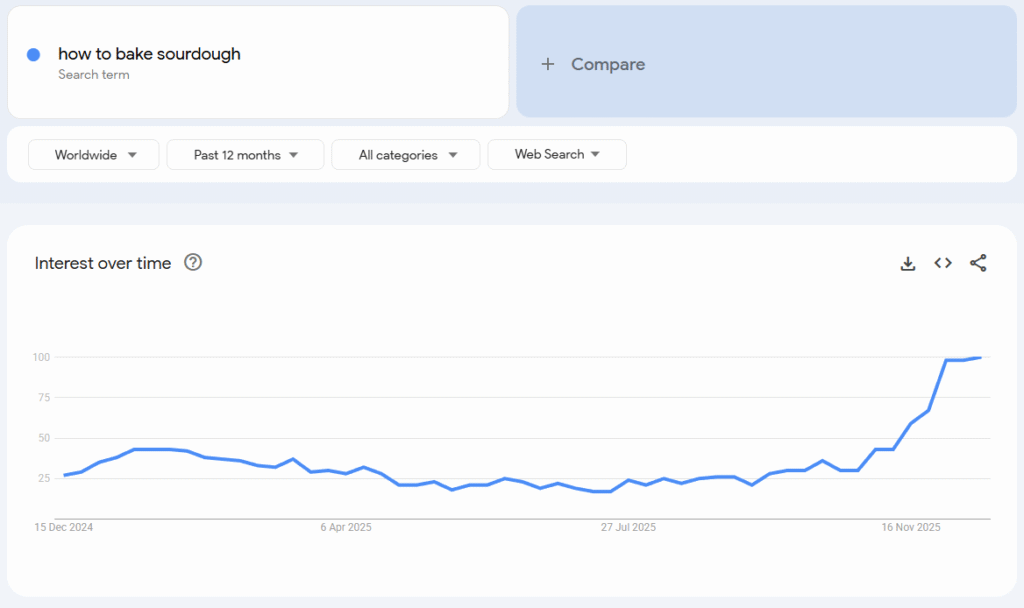
- AI Overviews (SGE) satisfy intent instantly: For established keywords (e.g., “how to bake sourdough”), Google’s AI Overview provides the full answer. There is no reason for the user to click your 2,000-word guide.
- LLMs already “know” the past: Gemini and OpenAI Search are trained on the existing web. If your content is just a better version of what’s already there, the LLM will synthesize it into a zero-click answer without credit.
- The Volume Lag: By the time a keyword shows “1,000 monthly searches” in a traditional SEO tool, the AI has already mapped the topic and the “Big Box” sites have claimed the real estate.
The 2026 Rule: If your topic is well-documented and frequently searched, AI doesn’t need your article. So Google doesn’t either.
The New SEO Goal: Information Gain
In 2026, Google prioritizes Information Gain. This is a patent-backed metric that rewards content for adding unique data to the collective knowledge graph.
To be cited by AI systems, you must introduce:
- A new angle: A perspective not found in the training data.
- A new entity: A brand, person, or tool that didn’t exist six months ago.
- First-hand experience: Proof that a human actually did the thing (E-E-A-T 2.0).
How Google Trends Reveals Topics AI Hasn’t “Learned” Yet
Most people use Google Trends to see what’s popular. That’s backward. To rank in 2026, you want instability.
Step 1: Use the “Rising” Filter (Not “Top”)
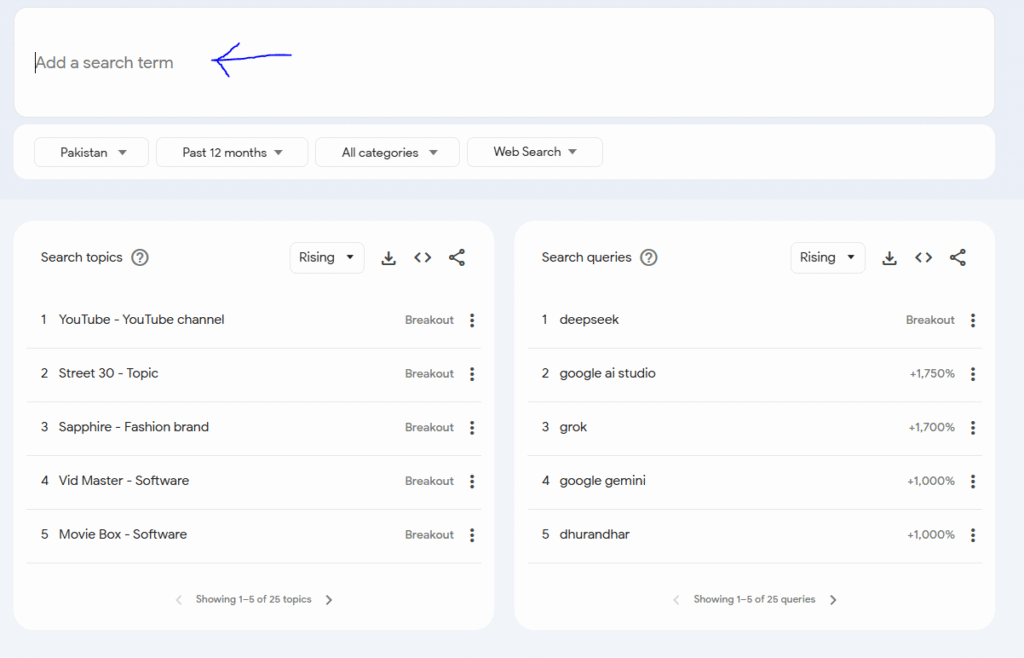
Go to Google Trends→Enter a broad topic → Scroll to Related Queries →Switch from Top to Rising.
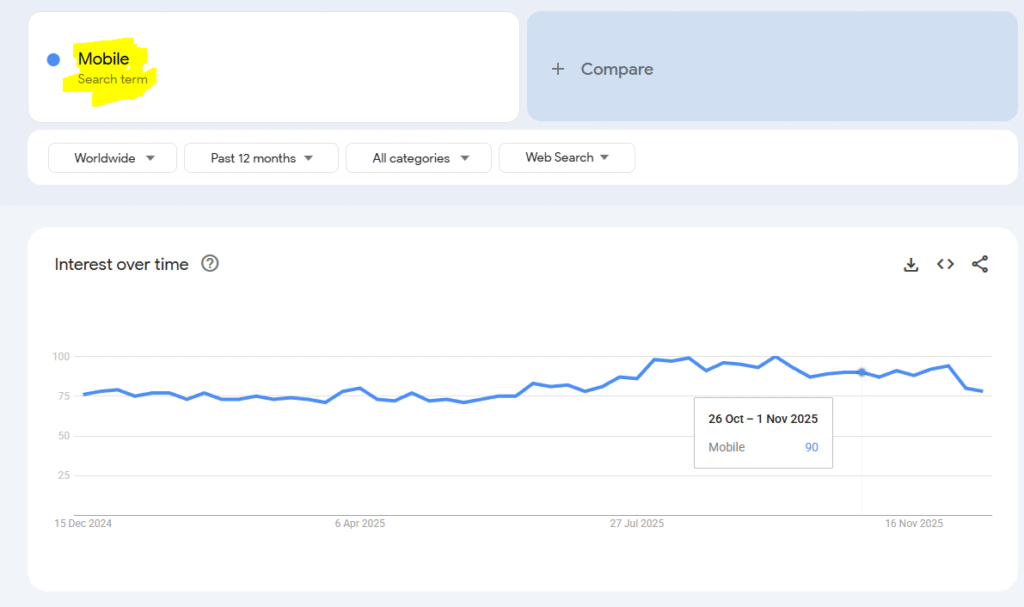
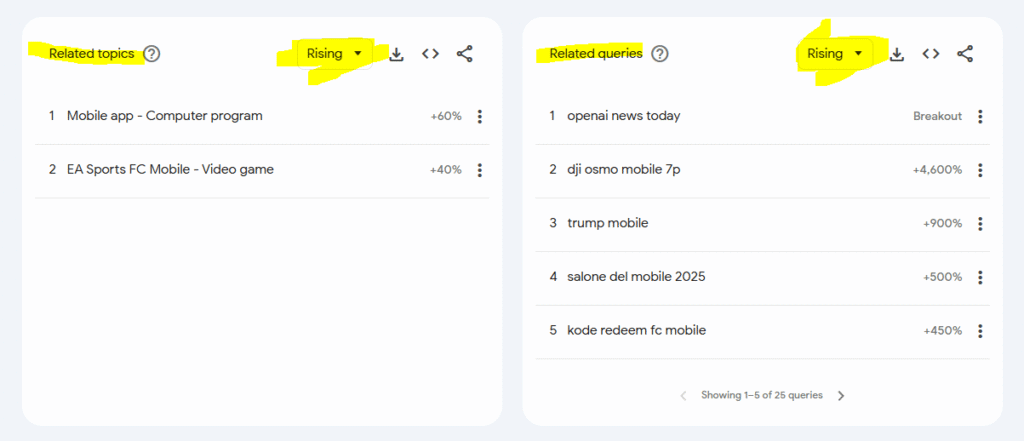
Look for:
- Queries marked “Breakout”: These have grown by more than 5,000%.
- Specific brand/product names: These indicate a new “Entity” is forming.
The “Breakout” Rule
If a query is labeled “Breakout,” publish content within 48 hours. At this stage, there is no established authority and the AI hasn’t formed a “consensus” answer yet. By being the first credible source, you become the Entity Originator.

The Gap Strategy: Demand vs. Answers
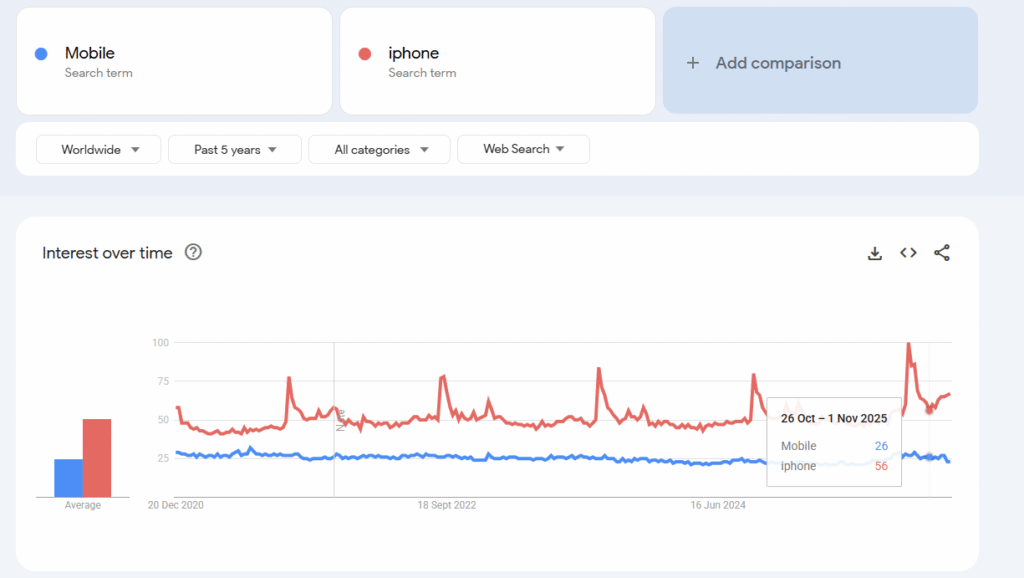
Compare two patterns in Google Trends:
- Sustained Interest (Past 5 Years): Shows the historical baseline.
- Trending Now (Past 90 Days): Shows the current heat.
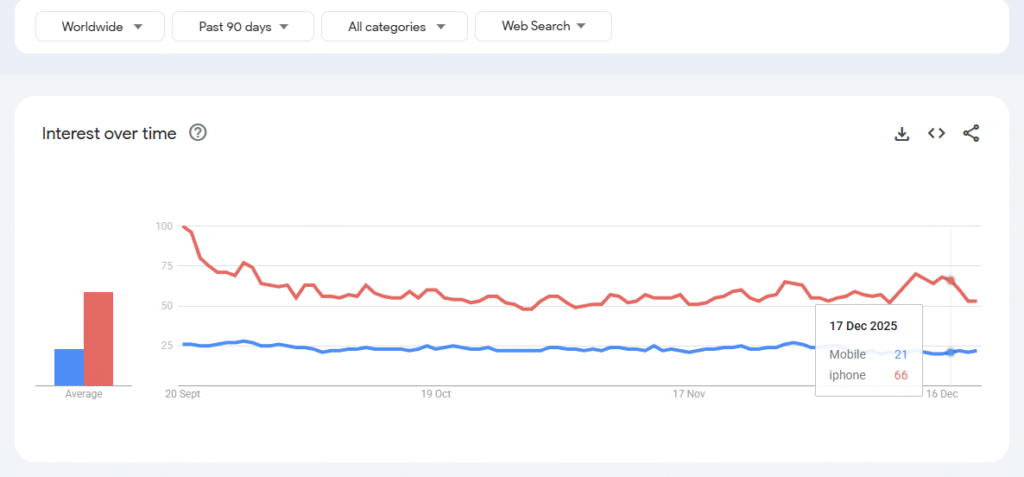
The “Predictive Gap” occurs when the 90-day view shows a sharp, vertical spike while the 5-year view shows nothing. This signals a cultural or technical shift. AI struggles with these “zero-day” topics because it has no historical context to fall back on. This is where human-created content wins.
Optimize for Where the Trend Is Happening
In 2026, “Search” is multimodal. Use the Google Trends dropdown to filter by platform:
- YouTube Search Spiking? AI Overviews now prioritize video clips for “How-to” queries. If the trend is on YouTube, your article must have an embedded video or it won’t be cited.
- Image Search Spiking? This signals commercial “Visual Intent.” Use high-res, original photography with descriptive ALT text. Google Lens now accounts for 20%+ of commercial discovery.
The 6-Week Publishing Rule
Use the Past 5 Years view to identify seasonal cycles.
- Identify the Peak: Find when a topic usually hits “100” (max interest).
- Backdate 6 Weeks: Publish your content six weeks before that date.
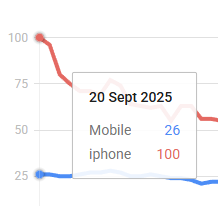
Google needs roughly 4–6 weeks to “bake” your content into its Knowledge Graph and for AI systems to verify your facts via RAG (Retrieval-Augmented Generation). If you publish during the peak, you’ve already lost to the early movers.
Local Predictive SEO
Use the Sub-region and City-level filters. In 2026, local AI search is hyper-targeted. A topic might be a “Breakout” in Austin, Texas, but “Flat” in the rest of the US.
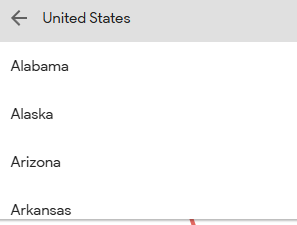
By creating localized pages for these specific “micro-trends,” you can capture massive visibility in a specific geography before the trend goes national.
Track the Ultimate Signal: Brand + Keyword
The strongest ranking signal in 2026 is Branded Demand.
Monitor Google Trends for queries like:
- “[Your Brand] + [New Trend]”
- “[Competitor] + [New Trend]”
If users are searching for your brand alongside a rising topic, Google’s Knowledge Graph “binds” you to that niche. This creates a moat that AI-generated “slop” content can never cross.
The 2026 Predictive SEO Workflow
- Weekly Audit: Check Google Trends for “Rising” and “Breakout” queries in your niche.
- Validate: Ensure the 90-day spike is vertical and lacks a long-term historical “answer.”
- Information Gain: Create content that adds a new data point, a case study, or a “human-in-the-loop” perspective.
- Format Match: If the trend is visual, lead with video/images. If it’s technical, lead with structured data and FAQ schema.
- Seed the Entity: Use social media to drive a small amount of “Brand + Keyword” search volume to solidify the connection in Google’s eyes.
Final Thoughts
SEO in 2026 rewards speed and human judgment. If AI already knows the answer, don’t waste your time competing. Find the questions the AI hasn’t learned yet—and answer them first.
Frequently Asked Questions (FAQs)
What is Predictive SEO in 2026?
Predictive SEO is the practice of identifying and publishing content on emerging search topics before they gain widespread awareness or competition. In 2026, it focuses on trend anticipation, entity creation, and information gain rather than historical keyword volume.
Why is traditional keyword research less effective in 2026?
Traditional keyword research relies on past search data. In 2026, AI Overviews and LLMs already summarize established topics, leading to fewer clicks and lower organic value for head terms. Predictive SEO targets future demand instead of existing volume.
How does Google Trends help with Predictive SEO?
Google Trends shows real-time and rising search behavior, helping SEOs detect breakout queries, sudden demand spikes, and emerging entities that AI systems haven’t fully processed yet.
What does “Breakout” mean in Google Trends?
A “Breakout” label indicates explosive growth—often +5000% or more—in a search query. These topics usually represent new products, problems, or concepts with little existing authoritative content.
What is Information Gain and why does it matter?
Information Gain refers to content that adds new knowledge to the web. In 2026, AI systems prioritize citing sources that introduce original insights, firsthand experience, or early explanations of emerging topics.
Can Google Trends help content get cited in AI Overviews?
Yes. Publishing early, authoritative content on breakout or rising topics increases the likelihood that AI Overviews will cite your page when performing grounded searches to update their answers.
How often should I check Google Trends for SEO?
For competitive niches, checking Google Trends weekly is ideal. Agencies and publishers targeting fast-moving industries should monitor it daily for breakout signals.
What is the best time to publish content using Google Trends data?
The optimal time is 4–6 weeks before a predicted demand peak. This gives search engines and AI systems enough time to crawl, evaluate, and trust your content before interest surges.
How does Predictive SEO support local SEO?
Google Trends allows filtering by sub-region and city, revealing localized breakout trends. Publishing location-specific content for these micro-markets improves visibility in local AI search results.
Why is branded search important in 2026 SEO?
Branded search growth indicates that users associate your brand with a specific topic. In 2026, this “Brand + Keyword” association is one of the strongest signals for entity authority and long-term rankings.
How does Google Trends support video and visual SEO?
By filtering trends across YouTube Search and Image Search, SEOs can identify when users prefer visual or video content. This helps optimize for multimodal search, including Google Lens and AI-powered SERPs.
Is Google Trends better than traditional SEO tools?
Google Trends doesn’t replace SEO tools—but it complements them. While tools show what has worked, Google Trends reveals what is about to matter, which is essential for Predictive SEO in 2026.
What types of websites benefit most from Predictive SEO?
Predictive SEO is especially powerful for:
- SaaS companies
- Content publishers
- SEO agencies
- White hat link building agencies
- Tech blogs
- Affiliate sites in fast-moving niches
Any site competing in AI-driven SERPs can benefit. n

Abdullah Zulfiqar writes about technology in a simple, practical way, helping readers stay updated and make smarter decisions in an ever-evolving digital world.